


Mission:
Creating global impact by unlocking the potential of overlooked resources.
Vision:
Solving the world’s gnarliest issues.
Watch our core values video below.
Core Values:
Resourceful – We are creative problem solvers who use what we have, and a can-do attitude, to overcome any challenge
Industrious – We work hard and get dirty to make our living
Stewardship – We serve and care for all that has been entrusted to us: our business, our people, our community and our planet
Entrepreneurial – We pursue overlooked opportunities and create new solutions – often from scratch
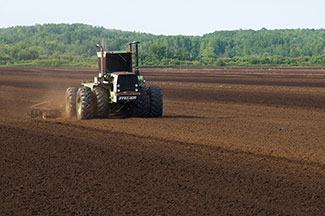
American Peat Technology harvests, dries and granulates reed-sedge peat, using peat from a prior-converted peat deposit. The harvest area looks much like a farm field, and has, in fact, been in some sort of agricultural production since its conversion in the early 1900’s. In the harvest field, the peat is nearly saturated with water and looks much like fibrous top soil. By the time the peat leaves the APT production facility, it has been transformed into a granular material.
In the Harvest Field:
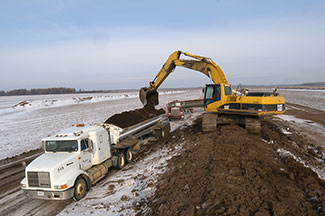
The peat harvest area is about a mile from the APT processing plant. Up until 2015, APT harvested peat with a windrow method. A portion of the 480-acre harvest area was disked throughout the summer to take advantage of drying caused by sun and wind, and the semi-dry peat was pushed into windrows. Each year, about three inches of peat were taken from the surface. Then, in the winter following the building of ice roads, the windrows were loaded into trailers and transported to the processing plant. APT now predominantly uses a second method that involves harvesting the peat to the maximum permitted depth. The primary benefit of the second method is that it is a more effective means of harvesting peat, and it also uses less energy inputs. It also allows for the staged restoration of the harvest area. APT harvests 8 – 12 acres of peat per year and begins the reclaiming process to the harvested acres almost immediately.
BioAPT
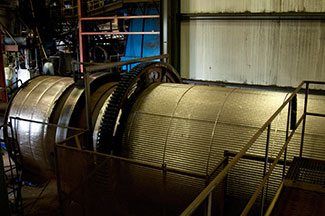
Drying peat from its harvested moisture content of 80 percent down to the product moisture content of 12 percent requires large amounts of energy. APT is constantly seeking ways to produce heat in efficient and environmentally-friendly ways. APT’s primary source of energy for drying is solid fuel biomass. After a primary drying step, the peat is pelletized and crumbled to produce a granular microbial carrier that meets agricultural specifications. BioAPT is also available in a powdered form which has the same specifications as granular BioAPT but has a much smaller particle size.
APTsorb and APTIVATOR
Our water remediation products are manufactured in a similar process to BioAPT, but they undergo an additional thermal step. The patented process to produce APTsorb and APTIVATOR involves a heat treatment step that gives the products granular strength in wet applications while retaining the sorption characteristics of the parent peat. [Sorption is the process by which one substance takes up or holds another.] Further, the surfaces of the products can be chemically modified to create specialty media to address other contaminants of concern. In partnership with the University of Minnesota’s Natural Resources Research Institute (NRRI) APT is engaged in research to develop a sorption media that will remove anions such as sulfates from water. Additionally, APT and NRRI are building on the knowledge gained through the sulfate media project to investigate other possible media applications such as mercury, selenium and arsenic.
APT’s unique operation requires highly skilled and motivated employees. A strong team is the secret behind APT’s success, and the company is committed to providing fair wages, a safe workplace, and opportunities for employees to focus on growth and development.
Benefits
APT offers a generous benefits package that includes medical, dental and life insurance, paid holidays off, and a 401 (K) savings plan with employer contributions.
Professional and Personal Development
APT encourages continued professional development through internal and external educational and training opportunities. A tuition reimbursement policy encourages employees to pursue further degrees or certificates. In addition, APT matches employee contributions to qualified charities and organizations.
The P.E.A.T Beat
Sign up for our Newsletter
Sign up for our newsletter and receive updates on our innovative products and events.
We are committed to sharing information with you about our projects. It is very important to us to keep the lines of communication open with all stakeholders. When we work together, great things can happen in Aitkin County.
FREE Product Samples